The short answer
Translate rough finish into a room-by-room list of what will be installed, supplied and left unfinished. Budget owner purchases and follow-on work before treating the quote as a complete renovation price.
In this guide
Ask what rough finish means in this proposal
The phrase is not a complete scope. Ask the bidder to list exactly where its work ends and what conditions it assumes. Does it include installation labor for owner-selected products, or only preparation? Who orders, receives and stores materials? A useful answer names the deliverables rather than repeating an industry shorthand you may interpret differently. See CSLB consumer guidance for the applicable official information.
Separate supply from installation
Create columns for product supplier, installer and related preparation or restoration. An owner-supplied fixture can still require installation labor, adapters, delivery coordination or a return if incompatible. Ask the contractor to review specifications before purchase. Do not assume buying an item yourself automatically eliminates every cost connected to it.
Add the work between the visible items
Look for paint, trim, transitions, disposal, protection and temporary facilities. These are easy to miss when comparing photographs of finished rooms with a proposal focused on rough trades. Check whether inspections and permits are included and who attends. A complete budget needs all required responsibilities, even when different vendors perform them.
Keep allowances visible
Record any allowance as an allowance rather than a final product selection. Ask what happens when the selected product costs more or less and whether labor changes too. Track selections before ordering deadlines. The problem is not that allowances exist; it is letting them disappear into a total that everyone later remembers as an all-inclusive promise.
Build a complete finish-responsibility register
Walk through each room and list the products you expect to see when it is usable. For each, identify who selects, orders, pays, receives and installs it. These are separate responsibilities. A countertop may be owner-selected, supplied by a fabricator and coordinated with cabinets installed by someone else. The register should show that chain instead of assigning everything to a vague materials category.
Then list the interfaces: measurements, support, cutouts, final connections, trim and repair. Ask who confirms that one item fits the next. An owner purchase can arrive on time and still be unusable if dimensions or connection requirements were never checked. Request review before ordering where the installation depends on those details.
Record allowances with their basis. Does the allowance relate to supply only, a defined quantity or a combined item? Ask how a different selection changes labor and other work. Do not treat the allowance as a guaranteed retail shopping budget unless the agreement says that. Keep the chosen product and the adjusted commitment together as selections are finalized.
Add delivery and storage questions. Who checks for damage, handles a wrong item and carries the cost of a return? What happens if a product arrives before there is a safe place to store it? These operational details can affect budget and schedule even when nobody changes the design. Document the plan instead of assuming the crew will absorb every inconvenience.
Finally, review the register against the contractor’s finish boundary. Highlight every task with no responsible provider and obtain the missing scope. Your complete budget should then distinguish the signed construction price, owner purchases, other contracts and unresolved allowances. This is not a request to inflate the budget with invented contingencies. It is a way to stop an attractive partial quote from being mistaken for the cost of a finished project.
Follow through on the decision
Before making the final budget decision, total only actual commitments and clearly identified estimates. Show owner purchases, separate contracts and allowances in different columns. Do not add alternative products together or treat an unselected option as a required cost. Ask the contractor to check whether your register misses any installation interface. Then decide which selections must be resolved before signing and which can remain open under a documented allowance. Review the register again before ordering, because a later layout change can make an earlier product choice unsuitable. The result should explain how the room becomes usable from the present condition through the final finish. If a substantial portion still has no provider or price basis, describe the budget as incomplete rather than announcing a misleading all-in number.
Decision checklist
- List who supplies, receives and installs each selected finish product.
- Identify the preparation and final connections between separate providers.
- Keep allowances, owner purchases and signed construction commitments distinct.
- Resolve unassigned work before describing the budget as an all-in total.
The cabinet is purchased, but the room is not finished
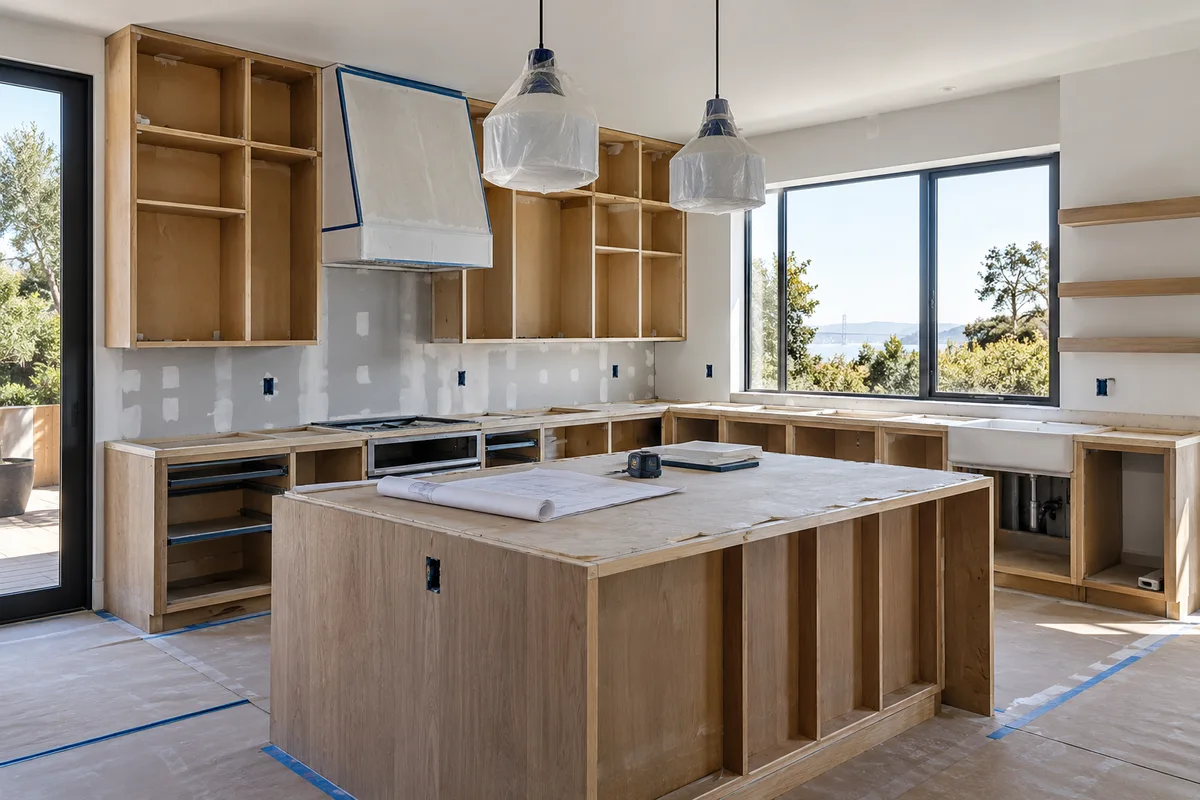
Hypothetical example. Suppose you buy cabinets while the construction quote covers rough plumbing and electrical only. You still need to identify who measures, installs, handles fillers and trim, coordinates counters and makes final connections. Do not add arbitrary online unit prices and assume the gap is solved. Ask for actual scopes from the responsible providers and track those commitments in the project budget.
Related questions
Does rough finish have one universal definition?
Do not rely on one. Require the proposal to describe the actual boundary.
Should I buy all finishes early?
Confirm specifications, storage, return terms and installation requirements first. Early purchases can create incompatibility or scheduling problems.
Official sources
Why readers ask this question
These public discussions informed the topic. Individual experiences are not permit rules, verified prices or professional advice.