The short answer
Document when and where water appears and obtain a qualified investigation before choosing a remedy. Keep structural condition, water source and discharge approval as separate questions.
In this guide
Record the pattern without diagnosing it
Note the dates, weather context, locations and visible effects from safely accessible areas. Retain photographs showing the same reference points where possible. Describe what you observed rather than labeling every occurrence groundwater or a foundation leak.
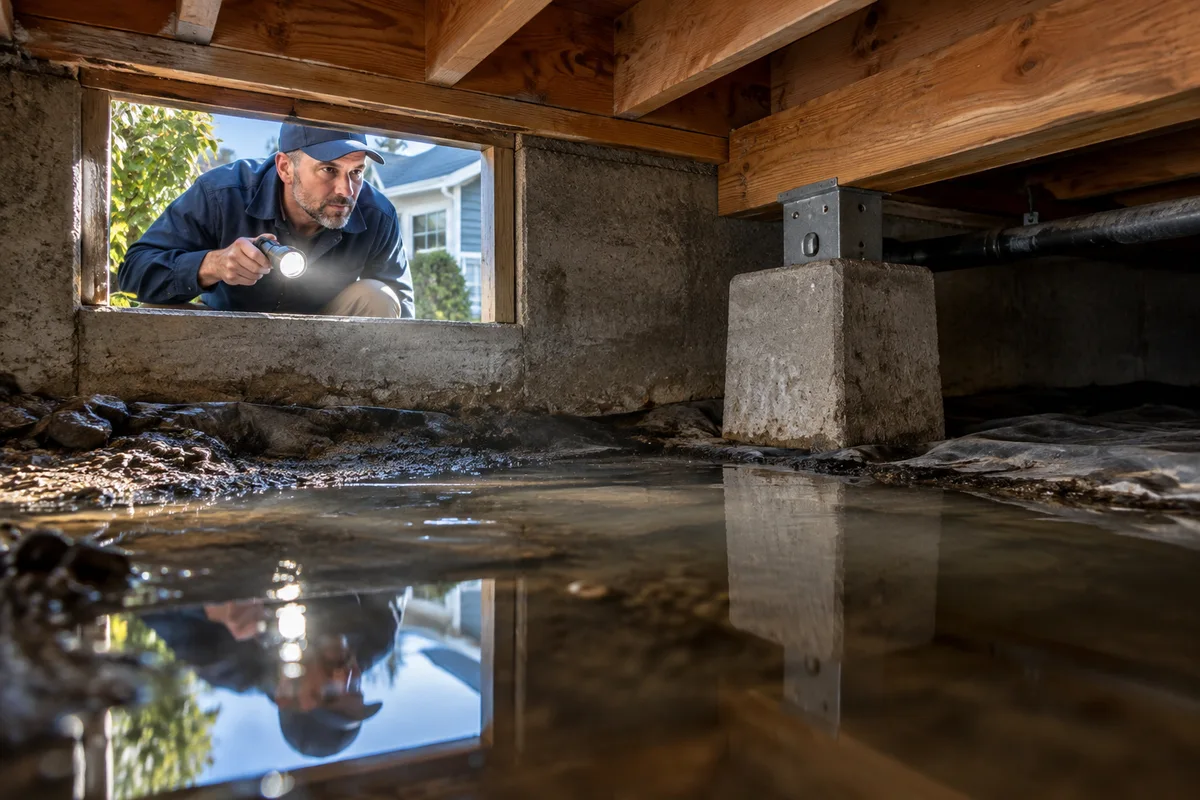
Do not enter unsafe confined areas or approach electrical hazards to gather evidence. The objective is a useful history for the professional. A dry inspection day does not by itself answer a question about an intermittent event, and one wet photograph cannot establish a cause.
Ask what investigation supports the proposal
Have each provider explain the suspected source, evidence, uncertainties and any additional specialist involvement. Ask whether the proposed work addresses water entry, drainage, damaged material or structural performance. Those can be related but are not identical assignments.
A hypothetical owner might receive a proposal for a perimeter drain while another provider raises a concern about a separate building condition. Before comparing prices, ask what each remedy is intended to solve and what it explicitly leaves unresolved.
Clarify the destination of collected water
A drainage proposal should identify the intended discharge approach and who confirms its permissibility with the relevant authority. Do not assume that collected water may be routed to any convenient pipe, street or neighboring area. The actual design and local requirements must govern.
This article does not provide drainage dimensions, pump sizing or a discharge detail. Those decisions require site-specific professional evaluation. Ask for the applicable approvals and design assumptions in the proposal rather than choosing from a generic diagram online.
Separate damage assessment from water control
If existing damage is reported, identify who evaluates it and how any repair is coordinated. A water-control project does not automatically establish that affected structural components are sound. Equally, a structural repair does not necessarily explain the moisture source.
San José Damage Repair Projects describes San José’s process for certain damaged-property repairs, while San José Plans That Require an Architect or Engineer outlines design-professional requirements. These are official entry points for that city, not a diagnosis or county-wide drainage rule.
Compare a complete investigation-and-work plan
Request phases where uncertainty is significant: investigation, findings, designed response, approvals, construction and evaluation. Ask what evidence would show whether the intended outcome has been achieved and what follow-up is included.
Your checklist should contain observed pattern, accessible evidence, suspected causes, investigation limits, specialist roles, discharge review, repair scope, restoration and follow-up. A thoughtful proposal can acknowledge uncertainty. An expensive system sold before the problem is understood may leave you unable to judge whether it addresses the actual concern.
Create a water-event record for the investigator
Use a consistent record for each observed event: date, accessible location, weather context, what changed and photographs from a safe position. Note household or construction changes that might matter, but label them as context rather than causes. Give the investigator the complete pattern, including occasions when the same area appeared dry.
Ask the professional to distinguish competing explanations and what evidence would help resolve them. A proposal should not simply name a preferred product. It should explain the problem being addressed, investigation limits and the intended outcome. Where the provider recommends another specialist, ask what that specialist needs to determine before construction is chosen.
A hypothetical owner could receive one bid aimed at collecting water and another aimed at preventing entry. Those approaches may have different assumptions about the source and different discharge implications. Before comparing totals, ask the providers to explain their assumptions on the same site information. You may need more investigation rather than another sales quote.
For any constructed response, request a scope that covers access, affected finishes, discharge review, operation, maintenance responsibilities and follow-up. If equipment is proposed, ask who explains its ordinary operation and what owner responsibilities accompany it. Do not assume that a buried system is maintenance-free because it is out of view.
Finally, define how the result will be assessed over the relevant conditions. A dry handoff on a sunny day may not answer a question about intermittent water. Have the provider describe an appropriate follow-up process and document its limits. This is not a guarantee that every event can be eliminated; it is a way to connect the proposed work with a measurable, project-specific objective.
Related questions
Does a dry crawlspace inspection rule out a water problem?
Not necessarily. Give the professional the history and observations from different conditions, and ask what the inspection can and cannot establish.
Should I immediately install a French drain?
A specific remedy should follow assessment of the actual source, site and permissible discharge. Compare the evidence and proposed outcome before selecting a system.
Official sources
Why readers ask this question
These public discussions informed the topic. Individual experiences are not permit rules, verified prices or professional advice.